
In Ethiopia, women are fighting to assert their property rights- La Croix Newsletter
By Augustine Passilly, special correspondent in Bishoftu and Yabelo (Ethiopia)
Although a law adopted in 2024 strengthened land rights for Ethiopian women living in rural areas, their struggle is far from over. Until recently, marriage was the only way for women to have their names recorded on a land title.
The A4 sheet bearing the stamps of the local authorities looks like a trophy. The document is dated September 16, 2025. “I received the land title I had been fighting for for 31 years,” says Emebet Zerfu. When her husband died, leaving her alone with two little girls, this resident of Bishoftu, 50 kilometers from Addis Ababa, rejected the arrangement proposed by her in-laws. “They wanted me to marry my husband’s brother,” says the bus ticket seller. “That would have allowed the house we lived in to remain in their family. I said I would rather die than marry my brother-in-law, so they took the matter to court…”
Two recent initiatives helped Emebet secure her victory. Launched in 2022 by the American NGO Landesa and funded in particular by Germany, the five-year campaign “Stand for Her Land” promotes women’s access to land ownership in eight countries, including Ethiopia. This advocacy work contributed to the adoption, in August 2024, of legislation strengthening Ethiopian women’s land rights.
“I want my daughters to be strong and independent”
“Under patriarchal customary practices, land is passed down through the male line. Women on their own could not claim land rights, even though no law prevented them from doing so,” explains Nardos Eshetu, campaign manager for “Stand for Her Land” at the Ethiopian NGO Habitat for Humanity. Until recently, marriage was the only way for Ethiopian women to have their names entered on a land title. But they often lost all privileges in the event of divorce or if their spouse died. “Especially since most experts ruling on land disputes are men,” Nardos Eshetu notes.
The new law requires regional governments to enforce legal provisions guaranteeing Ethiopian women’s property rights. It also allows women to be represented in court by specialized institutions to protect their land rights. Polygamous men are now required to update the registration of their plots in the event of a new marriage, in order to prevent disputes between wives.
The 25 NGOs active in the “Stand for Her Land” campaign play a fundamental role in implementing the legislation. Thanks to training provided by the Ethiopian Women and Children Associations Union (EWCAU), Tesfanesh Shewarega managed, in June, to register her eldest daughter’s name on the farmland that had belonged to her father, who died in 1989. “The knowledge I gained enabled me to stand up for myself,” says this potter from the southwest of the country. “I only have daughters. I want them to be strong and financially independent so they don’t remain trapped in poverty.”
A rotating savings system
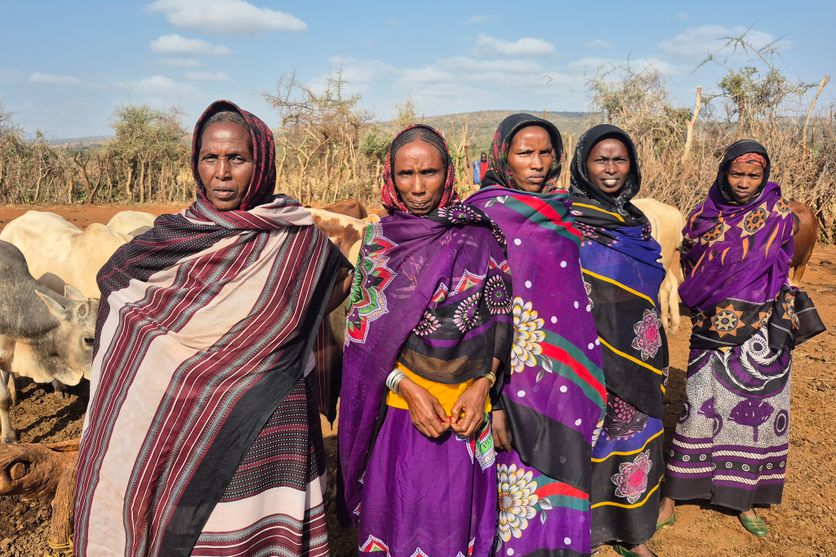
On the outskirts of Yabelo, a small town located 570 kilometers south of the capital, a cooperative of 25 village women is also benefiting from the ongoing revolution in Ethiopia’s countryside. A rotating savings system, combined with financial support from the local organization Gayo Pastoral Development Initiative, enabled these women herders to raise enough money to acquire 20 bulls. “Before buying them, we consulted elders from three villages to obtain grazing land. They agreed,” explains Kule Gayo, the cooperative’s president.
Although the current agreement is informal, Kule Gayo, 65, reveals the purpose of her next meeting with the council of elders: “We are going to ask them for a collective farm to grow cereals.” If successful once again, the cooperative would pay registration fees to the local administration. Its members would then, in turn, obtain a land title.